

Global Challenges in Transport: Infrastructures
Overview
The Global Challenges in Transport: Infrastructures online course gives transport professionals from around the world a unique opportunity to broaden their knowledge on the way transport infrastructures are planned, financed, evaluated, managed, and used.
Our insightful videos in combination with lively synchronous discussions with our expert speakers make this a great opportunity to reflect critically on your own work and broaden your international network of transport professionals tackling the infrastructure challenges around the world.
Academics from the Transport Studies Unit at Oxford University will be joined by experts from different sectors and contexts in delivering this course aimed at exploring how urban mobility depends on infrastructures that are accessible, flexible, and sustainable. We will look beyond the hardware of trains and buses to discuss the importance of systems and people in fostering a lively urban environment in various global contexts.
Global Challenges in Transport: Infrastructures | Status: CLOSED |
| Course Director: Dr Helen Morrissey | |
| Dates: 20 October – 26 November 2026 (plus final submission session early in December) | |
| Course Format: Online: two live sessions with international experts every week! | |
| Course Length: 6 teaching weeks | |
| Course Fee: Private sector £2,750; Public sector £1,650. Discounts and scholarships available. | |
| Key Dates: Last day for scholarships and general applications: Sunday 27 September 2026 | |
| Applications closed > | |
Learning Objectives
- To broaden transport professionals' understanding of how transport infrastructures can be evaluated, managed, and planned.
- To reflect critically on the way infrastructures are used (or not used) by different people or groups in urban settings.
- To develop an enhanced understanding of the links between transport infrastructures and economic, social, and environmental components of sustainable development.
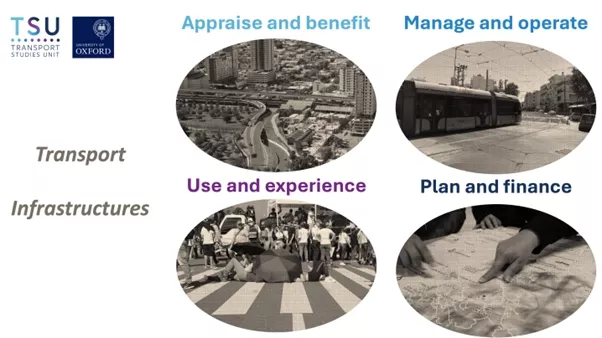
Four ovals highlighting the four main topics of the course: Appraise and benefit (showing a city), manage and operate (showing a tram), use and experience (showing two people in a crossing), and plan and finance (showing hands on a map).
Learning Outcomes
After attending this course, you will be able to:
- Apply to your own transport practice some of the lessons learnt from other transport infrastructure case studies around the world.
- Utilise a variety of theoretical and methodological approaches for transport infrastructure appraisal, planning and management.
- Understand and critically evaluate the relationships between transport infrastructure and the people who use it.
Course content and lecturers
The Infrastructures course begins with an introductory week followed by four weeks of teaching on topics covering planning, finance, geopolitics, benefits, appraisal, management and use of transport infrastructures. Before concluding with group work submissions, we will close the course with a reflective session on the preceding weeks.
As is now tradition in our courses we will begin with opportunities from participants to quickly share their work and expertise with colleagues through Pecha Kucha-style presentations, and will end with group presentations that combine participants own knowledge with the insights learnt throughout.
The Infrastructures course begins with an introductory week where participants are invited to quickly share their work and expertise with colleagues through Pecha Kucha-style presentations. This is then followed by four weeks of teaching on topics covering the planning, financing, geopolitics, benefits, appraisal, management and use of transport infrastructures. We then close the course with a reflective session on the preceding weeks, followed by group work submissions. This allows participants to combine their own knowledge with the insights learnt throughout.
Our sessions will include lectures from:
Course Schedule
The course has an estimated time commitment of approximately 42 hours including individual study, small group work, and live sessions.
Individual study includes working through pre-recorded lectures and additional material suggested by lecturers. This will entail approximately 1.5 hours of individual work per session.
Live sessions last 1.5 hours and take place twice a week, on Tuesdays and Thursdays from 12:30 UK time.
Tutorials: Participants will be divided into small groups that will meet for 30-minute sessions on Fridays. Exact times for tutorial sessions will be agreed with participants once the course starts. Attendance to tutorials is mandatory.
In the first week there is an additional Friday session at 12:30 (no tutorials) for the Pecha Kucha-style presentations.
| Mon | Tue | Wed | Thu | Fri |
|---|---|---|---|---|
| Week 1 - Introduction | ||||
19 Oct | 20 Oct
| 21 Oct | 22 Oct
| 23 Oct
|
| Week 2 - Plan and finance | ||||
26 Oct | 27 Oct
| 28 Oct | 29 Oct
| 30 Oct
|
| Week 3 - Geopolitics | ||||
2 Nov | 3 Nov
| 4 Nov | 5 Nov
| 6 Nov
|
| Week 4 - Management and use | ||||
9 Nov | 10 Nov
| 11 Nov | 12 Nov
| 13 Nov
|
| Week 5 - Benefit and appraisal | ||||
16 Nov | 17 Nov
| 18 Nov | 19 Nov
| 20 Nov
|
| Week 6 - Conclusions | ||||
23 Nov | 24 Nov
| 25 Nov | 26 Nov
| 27 Nov
|
Please note that the programme is indicative and may be subject to change.
Who should attend?
The Infrastructures course is designed for experienced professionals and researchers with a minimum of 3 years' experience in transport or a related field. We aim to bring together the world's leading experts from academia, policy and practice to address complex transport challenges. The course is intended for those who are looking to expand their knowledge horizons and gain a more in-depth and interdisciplinary understanding of the challenges and solutions involved in delivering sustainable transport.
We specifically invite applications from:
- Professionals in the transport/mobility or urban consultancy sector in charge of implementing new solutions relating to transport infrastructures.
- Individuals with experience in transportation consulting, planning, and related government agencies.
- Academics and researchers in transportation planning, civil engineering, economics, planning, and/or urban mobility.
Scholarship Opportunities
Various discount options as well as scholarship opportunities are available. Find out more about our scholarships or contact us: exed@tsu.ox.ac.uk
Or find out more about our Global Challenges in Transport Programme and our other courses
In brief
This 6-week online course introduces a range of approaches to thinking about transport infrastructures, with particular emphasis on the interaction between transport systems and users. It proposes a variety of theoretical and methodological approaches for developing mobility alternatives able to foster sustainable development.
The course adopts a strong interdisciplinary and interactive approach including insights from social science, environmental science, and both human and physical geography. Through its live sessions, participants get real-time interaction with experts from around the world and course lecturers.
The estimated time commitment for this course is 42 hours including independent study, group work, and live sessions.